


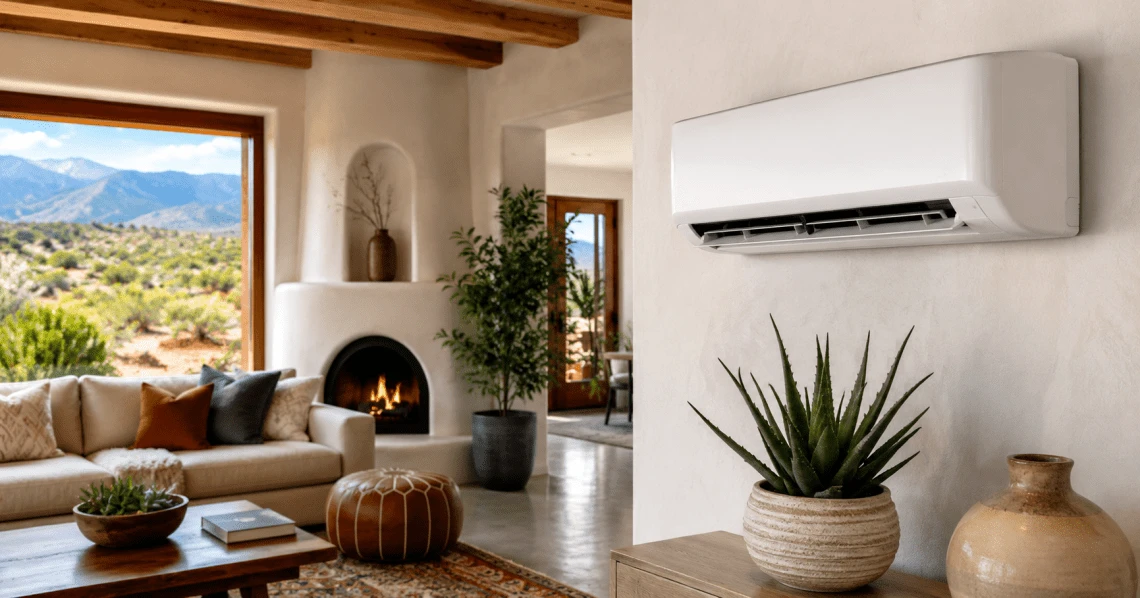
If you’ve been researching a new heating and cooling system, you’ve probably noticed that mini split systems are everywhere. More homeowners in Santa Fe are replacing aging swamp coolers, upgrading older HVAC systems, and installing ductless mini splits in homes that have never had central air.
But are they actually worth the investment?
The short answer is yes—for many Santa Fe homeowners, a mini split is one of the most efficient and comfortable HVAC systems available. However, like any major home improvement, the right choice depends on your home’s layout, your comfort goals, your budget, and the way you use your heating and cooling system.
In this guide, we’ll answer the most common questions homeowners ask before buying a ductless system, including:
- What is a mini split and how does it work?
- How much does a mini split cost in Santa Fe, NM?
- Are mini splits better than central air?
- Do mini splits work well in New Mexico winters?
- How much can you save on energy bills?
- What are the pros and cons?
- Which homes benefit the most from a ductless mini split?
By the end, you’ll have a much clearer understanding of whether a mini split system is the right investment for your home.
Why Mini Splits Have Become So Popular in Santa Fe
Over the past decade, ductless mini split systems have gone from being a niche product to one of the fastest-growing HVAC solutions in New Mexico.
That’s because they solve many of the challenges homeowners in Santa Fe face every year.
Unlike many parts of the country, Santa Fe experiences:
- Hot, sunny summers
- Cold winter nights
- Very low humidity
- Significant day-to-night temperature swings
- Older homes without ductwork
- Rising utility costs
Traditional HVAC systems don’t always perform efficiently under these conditions. Many homeowners are also looking for alternatives to swamp coolers that provide better comfort without dramatically increasing their monthly energy bills.
Mini splits check nearly every box.
They provide:
- Heating and cooling in one system
- Exceptional energy efficiency
- Individual room temperature control
- Quiet operation
- Easy installation
- Excellent comfort throughout the year
For these reasons, mini split installation in Santa Fe has become one of the most requested HVAC upgrades in recent years.
What Is a Mini Split System?
A mini split, also called a ductless mini split, is a heating and cooling system that doesn’t require traditional ductwork.
Instead of using one large indoor unit connected to air ducts throughout the home, a mini split uses:
- An outdoor condenser
- One or more indoor air handlers
- Refrigerant lines connecting the two
Each indoor unit controls its own area or “zone.”
That means your living room, bedroom, office, or guest suite can all be set to different temperatures.
Instead of cooling your entire home to satisfy one room, mini splits cool exactly where cooling is needed.
The result is:
- Better comfort
- Less wasted energy
- Lower utility bills
- More precise temperature control
How Does a Mini Split Work?
Many homeowners assume a mini split is simply a smaller air conditioner.
It’s actually much more advanced.
Most modern mini splits are heat pumps, meaning they can both cool and heat your home.
During Summer
The indoor unit absorbs heat from inside your home and transfers it outside.
This cools the room while also removing excess moisture from the air.
During Winter
The process reverses.
Even when outdoor temperatures drop below freezing, the system extracts heat from the outside air and transfers it indoors.
Today’s cold-climate mini splits are remarkably efficient, making them an excellent heating solution for Santa Fe winters.
Why Mini Splits Are So Energy Efficient
One of the biggest reasons homeowners search for energy-efficient HVAC in Santa Fe is the rising cost of electricity.
Mini splits are among the most efficient HVAC systems available today because they eliminate two major sources of wasted energy.
No Energy Loss Through Ductwork
According to the U.S. Department of Energy, traditional duct systems can lose up to 30% of conditioned air through leaks, poor insulation, and unconditioned spaces like attics or crawl spaces.
Mini splits don’t use ducts.
Every bit of cooled or heated air goes directly into the room where it’s needed.
Inverter Technology
Older HVAC systems operate like a light switch:
ON.
OFF.
ON.
OFF.
Every startup requires a large amount of electricity.
Mini splits use variable-speed inverter compressors that automatically adjust output based on demand.
Instead of repeatedly cycling on and off, they maintain a steady temperature while using significantly less energy.
This provides:
- Better comfort
- Quieter operation
- Lower utility bills
- Longer equipment life
Why Santa Fe Homes Are Perfect Candidates for Mini Splits
Few cities are better suited for ductless systems than Santa Fe.
Many homes here share characteristics that make mini splits especially effective.
Older Adobe Homes
Adobe homes often weren’t designed with central ductwork.
Installing ducts can require:
- Extensive remodeling
- Ceiling modifications
- Structural work
- Significant expense
Mini splits avoid all of that.
Only a small opening is needed to connect the indoor and outdoor units.
This makes them one of the most practical HVAC upgrades for historic and adobe homes.
Casitas and Guest Houses
Santa Fe properties frequently include detached guest homes or casitas.
Installing separate ductwork for these buildings rarely makes financial sense.
Mini splits provide independent heating and cooling while allowing guests to control their own comfort.
Home Additions
Building a new addition?
Instead of replacing your entire HVAC system or extending existing ductwork, a mini split provides efficient comfort without affecting the rest of the house.
Garages and Workshops
Whether you’re converting your garage into a gym, office, or workshop, mini splits offer year-round comfort without major renovations.
Homes Replacing Swamp Coolers
Many Santa Fe homeowners eventually become frustrated with swamp coolers because they:
- Lose effectiveness during monsoon season
- Add moisture indoors
- Require seasonal maintenance
- Don’t provide heating
Mini splits solve all of these problems while delivering much more consistent comfort.
Mini Split vs Central Air
One of the biggest decisions homeowners face is choosing between a mini split system and a traditional central air conditioner.
Both systems can cool your home effectively, but they work very differently.
Central Air Advantages
Central air conditioning remains a great option for homes that already have:
- Well-designed ductwork
- Even airflow
- A relatively new furnace
- Larger floor plans
Benefits include:
- Whole-home cooling
- One thermostat
- Familiar operation
- Hidden ductwork
Mini Split Advantages
Mini splits excel when homeowners want:
- Higher efficiency
- Zoned temperature control
- No ductwork
- Room-by-room comfort
- Heating and cooling in one system
- Easier installation
They’re especially attractive for:
- Older homes
- Remodels
- Historic properties
- Additions
- Garages
- Casitas
Which Is Better?
There isn’t one answer for every home.
If your house already has modern ductwork that’s in excellent condition, central air may continue to be the right solution.
If your home has older ductwork—or none at all—a ductless mini split in Santa Fe often provides better efficiency, greater flexibility, and lower long-term operating costs.
Are Mini Splits Comfortable Enough for an Entire Home?
This is one of the biggest questions homeowners ask.
The answer is:
Absolutely—when the system is properly designed.
Modern multi-zone systems can heat and cool an entire home while allowing different temperatures in different rooms.
For example:
- Living room: 72°F
- Primary bedroom: 68°F
- Guest room: 75°F
- Office: 70°F
Everyone stays comfortable without constantly adjusting a central thermostat.
That’s something traditional HVAC systems simply can’t match.
How Much Does a Mini Split Cost in Santa Fe, NM?
One of the first questions homeowners ask is:
“How much does a mini split cost in Santa Fe?”
The honest answer is—it depends.
Several factors affect the total cost of a mini split installation in Santa Fe, including the size of your home, the number of rooms you want to heat and cool, the efficiency of the equipment, and the complexity of the installation.
While it’s tempting to shop based solely on price, it’s important to remember that a mini split is a long-term investment. Choosing the right system can lower your monthly utility bills, improve your comfort, and reduce future repair costs.
Factors That Affect Mini Split Installation Cost
Every home is different, which is why no two installations cost exactly the same.
The biggest pricing factors include:
Number of Indoor Units (Zones)
Mini split systems can be configured with:
- One indoor unit (single-zone)
- Two indoor units
- Three or more indoor units (multi-zone)
Generally, adding more zones increases installation costs but also provides greater flexibility and comfort.
For example:
- A single-zone system may cool a garage, office, or casita.
- A multi-zone system can heat and cool an entire home while allowing each room to have its own thermostat.
Home Size
Larger homes require:
- More cooling capacity
- Larger outdoor units
- Additional indoor air handlers
Proper sizing is critical. A system that’s too small will struggle to keep up during the hottest days of summer, while an oversized system can cycle too frequently and reduce efficiency.
Installation Complexity
Some homes are easier to install than others.
Factors that can affect labor include:
- Two-story homes
- Long refrigerant line runs
- Electrical upgrades
- Historic adobe construction
- Limited outdoor unit placement options
Equipment Efficiency
Like traditional HVAC systems, mini splits come in various efficiency ratings.
Higher-efficiency systems generally:
- Cost more upfront
- Use less electricity
- Qualify for rebates more often
- Save more money over time
Are Mini Splits Worth the Higher Upfront Cost?
Compared to some traditional cooling systems, mini splits often require a larger initial investment.
So why do so many homeowners choose them?
Because ownership costs extend far beyond installation day.
Many homeowners recover much of the additional investment through:
- Lower energy bills
- Fewer repairs
- Longer equipment life
- Reduced maintenance
- Better comfort
- Increased home value
When viewed over 15–20 years, mini splits often become one of the most cost-effective HVAC investments available.
How Much Can You Save on Energy Bills?
One of the biggest reasons homeowners choose energy-efficient HVAC in Santa Fe is the opportunity to reduce monthly utility costs.
While every home is different, mini splits often use significantly less electricity than:
- Older central air systems
- Electric baseboard heaters
- Window AC units
- Portable air conditioners
Several features contribute to these savings.
Zoned Heating and Cooling
Instead of conditioning your entire home, mini splits only heat or cool the rooms you’re actually using.
For example:
If everyone is spending the evening in the family room, there’s no reason to cool unused guest bedrooms.
That flexibility alone can dramatically reduce energy consumption.
Variable-Speed Operation
Unlike older systems that repeatedly turn completely on and off, mini splits continuously adjust their output.
Benefits include:
- Stable indoor temperatures
- Lower electrical demand
- Fewer temperature swings
- Reduced equipment wear
No Duct Loss
One of the hidden energy drains in many homes is leaking ductwork.
Conditioned air escaping into:
- Attics
- Crawl spaces
- Wall cavities
…never reaches your living space.
Since mini splits don’t rely on ducts, that energy loss is eliminated.
Do Mini Splits Work During Santa Fe Winters?
Absolutely.
This is probably the biggest misconception surrounding ductless systems.
Many homeowners assume mini splits only provide cooling.
In reality, most modern systems are heat pumps, meaning they provide both heating and cooling.
Today’s cold-climate mini splits are engineered to perform efficiently even when temperatures drop below freezing.
That’s excellent news for Santa Fe homeowners.
Benefits During Winter
Mini splits provide:
- Consistent heating
- Quiet operation
- Room-by-room temperature control
- Lower operating costs than many electric heating systems
Many homeowners discover they use their mini split just as much in January as they do in July.
Mini Split vs Swamp Cooler
This comparison is especially important in New Mexico.
Swamp coolers have served homeowners well for decades because they perform efficiently in dry climates.
However, today’s homeowners often expect more than basic cooling.
Let’s compare them.
| Feature | Mini Split | Swamp Cooler |
|---|---|---|
| Cooling Performance | Excellent | Good in dry weather |
| Heating | ✔ Yes | ✘ No |
| Humidity Control | Removes humidity | Adds humidity |
| Monsoon Performance | Excellent | Reduced performance |
| Air Filtration | Excellent | Limited |
| Indoor Air Quality | Better | Moderate |
| Temperature Control | Precise | Less precise |
| Zoned Comfort | ✔ Yes | ✘ No |
| Noise Level | Very quiet | Louder |
| Maintenance | Low | Seasonal maintenance |
Swamp coolers remain an economical cooling option for many homes.
However, homeowners who prioritize:
- Comfort
- Air quality
- Heating capability
- Quiet operation
- Year-round use
often find mini splits to be the better long-term solution.
Mini Splits and Indoor Air Quality
Indoor air quality has become a much bigger concern in recent years.
Santa Fe homeowners regularly deal with:
- Dust
- Pollen
- Wildfire smoke
- Pet dander
- Seasonal allergens
Mini split systems help improve indoor air quality by incorporating advanced filtration directly into each indoor unit.
Benefits include:
- Cleaner air
- Reduced airborne dust
- Better allergy control
- Less debris circulating throughout the home
Unlike traditional duct systems, mini splits also avoid years of dust accumulation inside ductwork.
Can Mini Splits Increase Home Value?
While every real estate market is different, many buyers appreciate homes with:
- High-efficiency HVAC
- Lower utility costs
- Modern heating and cooling
- Smart home compatibility
In Santa Fe—where many homes don’t have central air—a professionally installed ductless mini split can make a property more attractive to future buyers.
Are Mini Splits Quiet?
One of the first things homeowners notice after installation is how quiet they are.
Indoor air handlers typically operate much more quietly than:
- Window AC units
- Portable air conditioners
- Older central HVAC systems
Many people barely notice they’re running.
That makes them ideal for:
- Bedrooms
- Home offices
- Nurseries
- Living rooms
Common Myths About Mini Splits
Myth #1: They’re Only for Small Homes
Not true.
Modern multi-zone systems can comfortably heat and cool entire homes.
Myth #2: They Don’t Work in Cold Weather
False.
Today’s heat pump technology is specifically designed for cold climates like Northern New Mexico.
Myth #3: They’re Ugly
Manufacturers now offer sleek, low-profile indoor units that blend well with modern interiors.
Some systems can even be installed:
- Recessed into ceilings
- Concealed in soffits
- Mounted near ceilings with minimal visual impact
Myth #4: They’re Too Expensive
While upfront costs can be higher than some alternatives, many homeowners save significantly over the life of the system through lower utility bills, reduced maintenance, and improved efficiency.
Are Mini Splits Really Worth It?
For many Santa Fe homeowners, the answer is yes.
If you’re looking for:
- Lower energy bills
- Heating and cooling in one system
- Zoned comfort
- Quiet operation
- Better indoor air quality
- No ductwork
- Reliable year-round performance
it’s hard to find a better HVAC solution than a modern ductless mini split.
Mini Split Pros and Cons
Like any HVAC system, ductless mini splits have strengths and limitations. Understanding both sides will help you make the best decision for your home and budget.
Pros of Mini Split Systems
Exceptional Energy Efficiency
One of the biggest advantages of a mini split in Santa Fe is its outstanding energy efficiency.
Because these systems:
- Don’t lose energy through ductwork
- Continuously adjust output with inverter technology
- Allow zoned heating and cooling
…they often consume significantly less electricity than older HVAC systems.
For many homeowners, that translates into lower monthly utility bills and long-term savings.
Year-Round Heating and Cooling
Unlike swamp coolers or traditional air conditioners, most mini splits are heat pumps, meaning one system provides comfort in every season.
Instead of maintaining separate systems for summer and winter, homeowners enjoy:
✔ Air conditioning in summer
✔ Heating in winter
✔ One thermostat system
✔ One maintenance schedule
Room-by-Room Temperature Control
Every family has different comfort preferences.
One person likes sleeping in a cool room.
Another wants the living room warmer.
Mini splits make everyone happy.
Each indoor unit has its own thermostat, allowing customized comfort throughout the home.
This also means you’re not paying to cool unused rooms.
Quiet Operation
Indoor units operate quietly enough that many homeowners forget they’re running.
Compared to:
- Window air conditioners
- Portable AC units
- Older HVAC systems
Mini splits provide an incredibly peaceful indoor environment.
Better Indoor Air Quality
Because there are no ducts collecting years of dust and debris, mini splits often contribute to cleaner indoor air.
Most systems include multi-stage filtration that helps capture:
- Dust
- Pollen
- Pet dander
- Airborne particles
This can be especially helpful for allergy sufferers.
Easy Installation
Installing central air often requires:
- New ductwork
- Ceiling modifications
- Drywall repairs
- Major construction
Mini splits require only a small wall penetration for refrigerant lines, making installation much faster and less invasive.
Cons of Mini Split Systems
No HVAC system is perfect.
Mini splits also have a few considerations.
Higher Upfront Investment
Compared to swamp coolers or replacing an existing central AC condenser, mini splits typically cost more initially.
However, many homeowners offset that cost through:
- Lower utility bills
- Rebates
- Tax credits
- Reduced maintenance
- Longer equipment life
Visible Indoor Units
Unlike central air, the indoor air handler remains visible on the wall or ceiling.
Most homeowners find modern units sleek and unobtrusive, but appearance is a personal preference.
Filter Maintenance
Each indoor unit has its own washable filter.
Fortunately, cleaning takes only a few minutes and helps maintain peak efficiency.
Is a Mini Split Right for Your Home?
Mini splits aren’t the perfect solution for every home—but they’re an excellent fit for many properties in Santa Fe.
They’re ideal if you:
✔ Own an older adobe home
✔ Don’t have existing ductwork
✔ Are replacing a swamp cooler
✔ Want lower energy bills
✔ Need heating and cooling
✔ Have a home addition
✔ Want independent room temperatures
✔ Value quiet operation
When Central Air Might Be the Better Choice
A traditional central HVAC system may still make sense if:
- Your home already has modern, well-designed ductwork
- You prefer hidden indoor equipment
- Your entire home is served effectively by one thermostat
- You’re replacing an existing central system with minimal modifications
The best choice depends on your home’s layout, insulation, comfort needs, and long-term goals.
A professional evaluation is the best way to determine which option provides the greatest value.
Choosing the Right Mini Split System
Not all mini splits are created equal.
Choosing the right equipment starts with selecting the proper size and configuration.
Our team evaluates:
- Home size
- Room layout
- Ceiling height
- Window placement
- Insulation levels
- Sun exposure
- Existing electrical capacity
- Heating and cooling requirements
Proper sizing is one of the most important parts of a successful installation.
An undersized system may struggle during peak temperatures, while an oversized system can short-cycle, reduce efficiency, and wear out faster.
Features Worth Considering
Today’s premium mini split systems offer many features beyond simple heating and cooling.
Popular options include:
Variable-Speed Compressors
Provide quieter operation and maximize efficiency.
Wi-Fi Connectivity
Control your home’s temperature from anywhere using your smartphone.
Smart Thermostat Integration
Many systems work seamlessly with smart home technology and programmable schedules.
Advanced Air Filtration
Helps reduce:
- Dust
- Allergens
- Pet dander
- Airborne particles
Multi-Zone Systems
Allow each room to have its own temperature setting.
This is one of the biggest advantages over traditional central air.
Mini Split Maintenance
Like any HVAC equipment, mini splits perform best with regular maintenance.
Annual service helps:
- Maintain efficiency
- Extend system lifespan
- Prevent unexpected repairs
- Improve indoor air quality
- Protect manufacturer warranties
Professional maintenance typically includes:
- Cleaning indoor coils
- Cleaning outdoor coils
- Checking refrigerant pressures
- Inspecting electrical connections
- Cleaning condensate drains
- Inspecting blower assemblies
- Verifying system performance
Combined with regular homeowner filter cleaning, routine maintenance can keep a mini split operating efficiently for many years.
Why Homeowners Trust Salazar Heating, Cooling & Plumbing
Choosing the right HVAC contractor is just as important as choosing the right equipment.
At Salazar Heating, Cooling & Plumbing, we believe every installation should be designed specifically for the home—not based on a one-size-fits-all approach.
Our experienced technicians take the time to understand your goals, evaluate your home’s unique needs, and recommend the solution that provides the best long-term value.
When you choose Salazar, you can expect:
- Professional mini split installation
- Honest recommendations without high-pressure sales tactics
- High-quality workmanship
- Trusted equipment from leading manufacturers
- Thorough system testing
- Clear communication throughout the project
- Ongoing maintenance and support after installation
Whether you’re cooling a single room or upgrading your entire home’s HVAC system, we’re committed to delivering comfort you can rely on.
Frequently Asked Questions About Mini Splits
How long do mini split systems last?
With proper maintenance, most high-quality mini split systems last 15–20 years or more.
Can a mini split cool an entire house?
Yes. Multi-zone systems are designed to provide heating and cooling for multiple rooms—or an entire home—depending on the layout and equipment selected.
Do mini splits increase home value?
Many buyers appreciate energy-efficient HVAC systems, especially in homes without existing ductwork. While market conditions vary, a professionally installed mini split can make a home more attractive to potential buyers.
Are mini splits expensive to maintain?
No. Routine maintenance is generally straightforward and affordable. Regular filter cleaning and annual professional service help keep the system running efficiently and reduce the likelihood of costly repairs.
Do mini splits work during New Mexico winters?
Yes. Modern cold-climate heat pump mini splits are designed to operate efficiently even when outdoor temperatures fall below freezing, making them an excellent year-round comfort solution for Santa Fe homes.
Final Verdict: Are Mini Splits Worth It in Santa Fe?
For many homeowners, the answer is a resounding yes.
Santa Fe’s unique climate, abundance of older homes, and growing demand for energy-efficient heating and cooling make ductless mini splits one of the smartest HVAC investments available.
They offer:
- Outstanding energy efficiency
- Lower utility costs
- Zoned comfort
- Heating and cooling in one system
- Quiet operation
- Improved indoor air quality
- Flexible installation for homes with or without ductwork
While the upfront investment is often higher than a swamp cooler or basic AC replacement, the long-term benefits frequently outweigh the initial cost.
If you’re looking for a modern, efficient, and comfortable way to heat and cool your home, a mini split system deserves serious consideration.
Schedule Your Mini Split Consultation Today
If you’re thinking about installing a mini split in Santa Fe, let the experts at Salazar Heating, Cooling & Plumbing help you find the right system for your home.
We’ll evaluate your home’s layout, discuss your comfort goals, explain your options, and recommend a solution that fits your budget and delivers reliable year-round performance.
Whether you’re replacing a swamp cooler, upgrading an older HVAC system, or adding comfort to a new space, our experienced team is here to help.
Call Salazar Heating, Cooling & Plumbing today at (505) 820-2007 to schedule your consultation.
We’re proud to provide professional mini split installation, repair, and maintenance throughout Santa Fe and the surrounding communities, helping homeowners enjoy greater comfort, improved efficiency, and lower energy costs for years to come.