


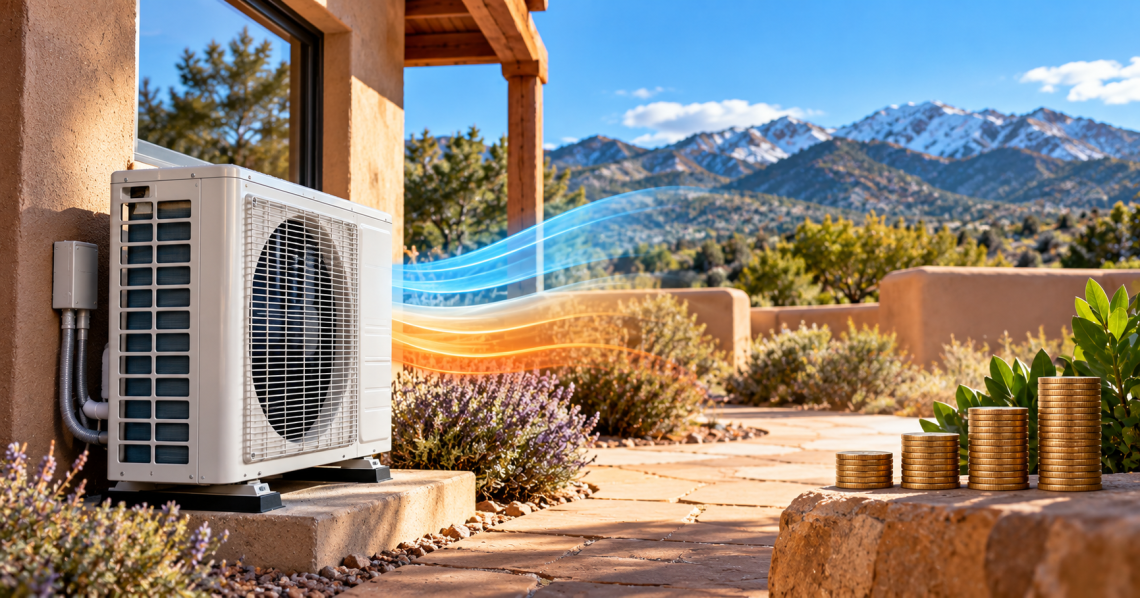
If you live in Santa Fe, you’ve probably noticed how much your heating and cooling needs can change throughout the year. Summer afternoons can get hot, winter nights regularly drop below freezing, and temperatures can swing considerably between daytime and nighttime.
Keeping your home comfortable through those changes can get expensive, especially if you’re relying on an older air conditioner, electric resistance heaters, or an inefficient heating and cooling system.
That’s one reason more homeowners are considering ductless mini splits.
But how much money can you actually save by installing one?
Mini split energy savings in Santa Fe depend on your existing HVAC system, electricity rates, home insulation, equipment efficiency, and how you use your heating and cooling. A properly installed mini split can significantly reduce electricity consumption compared with electric resistance heating and may reduce cooling energy use compared with older conventional air conditioners. However, savings are not guaranteed, and some existing systems may already be highly efficient.
For Santa Fe homeowners, the biggest benefit is often having one efficient system that can provide both heating and cooling while allowing better temperature control in individual rooms.
Let’s look at how mini splits work, how much electricity they use, and what determines whether they’re a worthwhile investment for your home.
What Makes Mini Splits More Energy Efficient Than Traditional HVAC Systems?
A ductless mini split is a type of heat pump that provides heating and cooling without requiring traditional ductwork.
Most systems include an outdoor compressor unit connected to one or more indoor air handlers. The indoor units deliver conditioned air directly into the rooms where they’re installed.
Mini splits can be especially efficient because of three important features.
1. They Avoid Ductwork Energy Losses
Traditional central HVAC systems distribute conditioned air through ducts.
If those ducts run through an attic, crawl space, or another unconditioned area, they can lose heating and cooling energy before the air reaches your living spaces.
According to the U.S. Department of Energy, duct losses can account for more than 30% of the energy used for space conditioning in some homes, particularly when ducts are located in unconditioned spaces.
Ductless mini splits eliminate those distribution losses for the rooms they serve.
This can be especially beneficial in older Santa Fe homes that were never designed for modern ductwork.
However, not every central HVAC system has significant duct losses. A well-sealed duct system located inside conditioned space may already operate efficiently.
2. They Use Variable-Speed Technology
Many modern mini splits use inverter-driven compressors.
Instead of constantly switching between full power and completely off, these systems can adjust their output to match the home’s heating or cooling needs.
Think of it like driving a car.
An older single-stage HVAC system often operates more like repeatedly accelerating and stopping. A variable-speed mini split can operate more like maintaining a steady speed.
That flexibility can reduce unnecessary energy consumption and help maintain more consistent indoor temperatures.
3. They Allow Zoned Heating and Cooling
With a mini split, you can control temperatures in specific rooms or areas.
For example, you might want:
- A cooler bedroom at night
- A comfortable home office during the day
- A guest room conditioned only when occupied
- A separate temperature setting for a casita
- Less heating or cooling in rooms that aren’t being used
This flexibility can reduce energy consumption when it allows you to condition less space.
However, zoning doesn’t automatically guarantee savings. If every room is kept at the same temperature all day, the benefit may be smaller.
How Much Energy Can a Mini Split Save in Santa Fe?
There isn’t one savings percentage that applies to every home.
A mini split replacing electric baseboard heaters may deliver substantial savings during the heating season. Replacing an older central air conditioner can also reduce cooling electricity use, particularly when the existing system has poor efficiency or leaky ducts.
On the other hand, replacing a relatively new, high-efficiency central heat pump may produce much smaller savings.
The most useful way to estimate potential savings is to compare how much electricity the existing equipment uses to provide the same amount of heating or cooling.
Mini Split Energy Savings Compared with Different HVAC Systems
| Existing HVAC system | Potential mini split advantage | Important consideration |
|---|---|---|
| Electric baseboard heaters | Often substantial heating electricity savings | Savings depend on seasonal heat pump efficiency |
| Portable electric space heaters | Potentially substantial heating electricity savings | Mini split must adequately serve the space |
| Older central air conditioner | May reduce cooling electricity consumption | Depends on SEER2 ratings and duct conditions |
| Older central heat pump | May improve efficiency and comfort | Compare actual equipment performance |
| Modern high-efficiency central heat pump | Savings may be relatively small | Existing system may already be efficient |
| Natural gas furnace | May reduce purchased heating energy | Lower energy use does not always mean lower bills |
| Evaporative cooler | Adds efficient heating and refrigerated cooling | Electricity costs may increase compared with evaporative cooling |
The biggest takeaway: A mini split’s value depends on what you’re replacing, not simply on the fact that it’s a mini split.
Mini Split vs Central Air: Which Uses Less Electricity?
One of the most common questions Santa Fe homeowners ask is whether a mini split uses less electricity than central air conditioning.
The answer is often yes when comparing an efficient mini split with an older, lower-efficiency central AC system, but the difference depends on the equipment and installation.
Understanding SEER2 Ratings
SEER2 stands for Seasonal Energy Efficiency Ratio 2.
It measures cooling efficiency under standardized testing conditions.
Generally, a higher SEER2 rating indicates that a system provides more cooling for each unit of electricity consumed.
For example, consider two cooling systems:
- Older central air conditioner: 10 SEER, under the older testing standard
- Modern mini split: 20 SEER2
The mini split has a substantially higher published efficiency rating.
However, because SEER and SEER2 use different testing procedures, those numbers should not be treated as directly interchangeable when calculating exact savings.
For a meaningful comparison, look at ratings under the same testing standard or use equipment-specific energy estimates.
Example: Comparing Cooling Electricity Consumption
Let’s compare two hypothetical systems using a common efficiency metric.
Assume both systems deliver 12 million BTUs of cooling over a period of time.
| System | Illustrative efficiency | Estimated electricity use |
|---|---|---|
| Lower-efficiency cooling system | 12 SEER2 | 1,000 kWh |
| Higher-efficiency mini split | 20 SEER2 | 600 kWh |
| Difference | 400 kWh |
In this simplified example, the more efficient system uses approximately 40% less electricity to deliver the same cooling output.
At an illustrative electricity price of $0.15 per kWh:
- Lower-efficiency system: $150
- Higher-efficiency system: $90
- Estimated difference: $60
This is an efficiency comparison, not a prediction of actual Santa Fe utility bills.
Real-world savings depend on equipment sizing, weather, runtime, duct losses, installation quality, thermostat settings, and actual utility rates.
Also, the total savings for a household depend on how much cooling the home requires during the year.
How Much Electricity Does a Mini Split Use?
A mini split’s electricity consumption depends on its capacity, efficiency, operating conditions, and the amount of heating or cooling required.
A small unit conditioning one bedroom will generally use less total electricity than a multi-zone system serving an entire house, assuming similar conditions.
But size alone doesn’t tell the whole story.
A properly sized, efficient system may run for longer periods at reduced output rather than frequently cycling at full capacity.
Example Mini Split Electricity Cost Calculator
The following calculator illustrates how electricity consumption translates into operating costs. Enter your estimated average electrical draw while the system is running, daily operating hours, and electricity rate.
Mini Split Electricity Cost Calculator
Estimate how much electricity your mini split uses and what it may cost to operate each month. Adjust the values below to match your system.
Estimates assume a 30-day month and a constant average power draw during the equivalent running hours selected. Actual electricity consumption varies with weather, thermostat settings, equipment efficiency, compressor modulation, and heating or cooling demand. Fixed utility charges are excluded.
To estimate the savings from a new mini split, you would also need to calculate the electricity consumption of the equipment you’re replacing.
Can Mini Splits Reduce Heating Costs During Santa Fe Winters?
Yes, and heating is one area where mini splits can offer a particularly meaningful efficiency advantage.
Modern mini splits are heat pumps. Instead of generating heat directly from electricity, they transfer heat from the outdoor air into the home.
Even when temperatures are below freezing, outdoor air contains thermal energy that a properly designed heat pump can extract.
This is fundamentally different from electric resistance heating.
Mini Split vs Electric Baseboard Heating
Electric baseboard heaters convert electricity directly into heat.
For every unit of electricity consumed, they deliver approximately one unit of heat energy.
Heat pumps can deliver more heat energy than the electrical energy they consume because they’re moving heat rather than producing it entirely through resistance.
This relationship is measured by the coefficient of performance, or COP.
For example:
- Electric resistance heater: approximately 1.0 COP
- Mini split operating at 2.5 COP: 2.5 units of heat delivered per unit of electricity
- Mini split operating at 3.0 COP: 3 units of heat delivered per unit of electricity
At a COP of 3.0, a mini split uses approximately one-third as much electricity as electric resistance heating to deliver the same heat output.
That represents about a 67% reduction in electricity consumption for the heating load being compared.
However, a heat pump’s COP changes with outdoor temperatures and operating conditions. The 3.0 example is not a guaranteed seasonal average for Santa Fe.
Do Mini Splits Still Save Energy When It’s Freezing?
Modern cold-climate mini splits are designed to provide heating at low outdoor temperatures.
Their efficiency and heating capacity generally change as outdoor temperatures drop.
A system that performs exceptionally well on a 45-degree afternoon may consume more electricity to deliver the same amount of heat on a much colder night.
That doesn’t mean the system stops working.
It means homeowners should choose equipment based on actual cold-weather performance, not just advertised cooling efficiency.
For Santa Fe homes, proper sizing and low-temperature heating capacity are particularly important.
For a more detailed explanation, see our related guide: Do Mini Splits Work in Cold Weather? Santa Fe Winter Guide.
Are Mini Splits Cheaper to Run Than Natural Gas Furnaces?
This question requires a different comparison.
A mini split may use energy more efficiently than a conventional gas furnace, but that doesn’t automatically mean it will cost less to operate.
Electricity and natural gas are billed using different units and prices.
A natural gas furnace burns fuel to generate heat. A mini split uses electricity to transfer heat.
The operating cost depends on:
- Local electricity rates
- Natural gas prices
- Furnace efficiency
- Heat pump seasonal efficiency
- Outdoor temperatures
- The home’s heating requirements
Example: Comparing Heating Energy Costs
Suppose a home requires 10 million BTUs of delivered heat.
For a simplified comparison, assume:
- Gas furnace: 95% efficiency
- Natural gas price: $1.50 per therm
- Mini split: average COP of 3.0
- Electricity price: $0.15 per kWh
| Heating system | Approximate energy required | Illustrative cost |
|---|---|---|
| 95% efficient gas furnace | 105.3 therms | $158 |
| Mini split at COP 3.0 | 977 kWh | $147 |
In this particular example, the mini split costs slightly less to operate.
But changing electricity prices, gas prices, or heat pump performance can reverse the result.
That’s why we recommend evaluating your existing heating equipment and utility costs before making the switch.
The financial value of a mini split may also include the ability to provide air conditioning, eliminate the need for separate cooling equipment, and improve temperature control.
Mini Split vs Swamp Cooler: Which Saves More Energy in Santa Fe?
Santa Fe’s dry climate makes evaporative cooling, commonly called swamp cooling, a practical option for many homes.
Evaporative coolers use water evaporation to lower air temperature.
Because they generally rely on fans and water pumps rather than refrigeration compressors, they can use considerably less electricity than refrigerated air conditioning.
So, will replacing a swamp cooler with a mini split reduce your cooling electricity bill?
Not necessarily. In many cases, a mini split will consume more electricity for cooling than an evaporative cooler.
However, mini splits provide advantages that swamp coolers cannot always offer.
Comparing Mini Splits and Evaporative Coolers
| Feature | Mini split | Swamp cooler |
|---|---|---|
| Cooling method | Refrigeration heat pump | Water evaporation |
| Electricity consumption | Varies with cooling demand | Generally lower |
| Water consumption | No evaporative cooling water supply | Requires water |
| Cooling during humid weather | Maintains refrigerated cooling | Effectiveness decreases |
| Temperature control | Precise thermostat control | Less precise |
| Winter heating | Yes, with heat pump models | No |
| Room-by-room zoning | Available | Depends on configuration |
| Cooling consistency | Less dependent on outdoor humidity | Strongly affected by humidity |
For homeowners who want dependable refrigerated cooling, heating capability, and more precise indoor temperature control, a mini split can be an attractive upgrade.
But the decision should be based on comfort, operating costs, water use, maintenance, and total system value rather than an assumption that refrigerated cooling always saves electricity.
Why Santa Fe’s Climate Makes Mini Split Efficiency Worth Considering
Santa Fe has a distinctive high-desert climate.
Hot summer afternoons, cool evenings, freezing winter nights, and substantial seasonal temperature changes create different HVAC demands throughout the year.
Mini splits can adapt well to these conditions when properly selected.
Cooling During Hot Summer Afternoons
A mini split can adjust its compressor speed as the cooling load changes.
When outdoor temperatures rise, the system increases output to maintain the thermostat setting.
As temperatures moderate, it can reduce output rather than continuing to operate at maximum capacity.
Reduced Cooling Demand at Night
Santa Fe’s cooler nighttime temperatures can reduce the amount of cooling a home needs.
A variable-speed system can respond to those lower demands.
Homeowners can also use appropriate thermostat schedules, window coverings, and ventilation strategies when outdoor conditions permit.
Efficient Heating During Mild Winter Days
Winter in Santa Fe doesn’t mean every hour is extremely cold.
On milder winter days, heat pumps can operate very efficiently.
Cold-climate equipment can continue providing heat as temperatures drop, although performance varies by model.
Heating and Cooling From One System
Perhaps the biggest practical advantage is having one system that handles both seasons.
Instead of maintaining separate cooling and electric heating equipment, a homeowner may be able to use a single mini split heat pump.
This can be particularly attractive for casitas, home additions, older adobe homes, and converted living spaces.
How Much Can Zoned Heating and Cooling Save?
Zoning is one of the most useful features of ductless HVAC systems.
Instead of conditioning an entire house uniformly, you can adjust individual areas based on occupancy and comfort needs.
For example, imagine a Santa Fe home with:
- A primary bedroom
- Two guest bedrooms
- A home office
- A living room
- A separate casita
The homeowners use the living room and office throughout the day, but the guest bedrooms remain unoccupied most of the week.
With an appropriately designed multi-zone mini split system, the occupied areas can receive more heating or cooling while unused areas operate at less demanding temperature settings.
This can reduce energy use compared with maintaining the same comfort temperature everywhere.
However, there are important limitations.
Zoning Doesn’t Mean Turning Every Unused Room Completely Off
In some homes, allowing unused rooms to become extremely hot or cold can create comfort problems, affect adjacent spaces, or increase the energy required to restore comfortable temperatures.
The best strategy depends on the building layout, insulation, equipment configuration, and how frequently the rooms are used.
Also, multi-zone mini splits are not automatically more efficient than multiple single-zone systems. Equipment performance and system design matter.
A professional HVAC contractor can help determine whether zoning makes sense for your home.
Are Mini Splits a Good Energy-Efficient HVAC Upgrade for Adobe Homes?
Many Santa Fe homes feature adobe construction, thick walls, unique room layouts, exposed beams, and architectural details that homeowners want to preserve.
Installing conventional ductwork in these homes can be difficult.
A ductless mini split provides another option.
Because indoor air handlers connect to an outdoor unit through relatively small refrigerant and electrical lines, installation can often be completed without adding extensive ducts.
This can reduce disruption to existing finishes.
Benefits for Older Santa Fe Homes
Mini splits may offer:
- Efficient heating and cooling without conventional ducts
- Individual temperature control for different rooms
- Reduced dependence on portable electric heaters
- Heating and cooling for additions without extending existing ductwork
- Improved comfort in rooms that are difficult to condition
However, adobe homes require careful HVAC design.
Thick masonry walls can influence thermal performance, but they do not automatically mean a home is well insulated.
Air leakage, roof insulation, window quality, solar exposure, and the home’s thermal mass all affect heating and cooling loads.
A professional load calculation is important before selecting equipment.
What Factors Affect Mini Split Energy Savings in Santa Fe?
Two homeowners can install similar mini split systems and experience very different utility bills.
That’s because equipment efficiency is only one part of the equation.
1. Existing HVAC Equipment
Replacing electric resistance heating generally creates a different savings opportunity than replacing a modern heat pump.
Before estimating savings, identify the existing system’s type, efficiency, condition, and actual operating costs.
2. Home Insulation and Air Leakage
Poor insulation and air leaks allow conditioned air and heat to move between the indoors and outdoors.
A high-efficiency mini split cannot fully compensate for a poorly performing building envelope.
Sealing air leaks and improving insulation can reduce the heating and cooling load before a new system is installed.
3. Equipment Sizing
Oversized equipment can create unnecessary installation costs and may operate less efficiently under certain conditions.
Undersized equipment may struggle to maintain comfortable temperatures during peak heating or cooling demand.
The correct system size should be based on a professional heating and cooling load calculation, not square footage alone.
4. Installation Quality
Refrigerant charge, airflow, line-set installation, condensate drainage, electrical work, and outdoor unit placement all influence system performance.
A highly rated mini split can perform poorly when installed incorrectly.
5. Thermostat Settings
Lower summer thermostat settings and higher winter thermostat settings increase the amount of work your HVAC system must perform.
Reasonable temperature adjustments can help control energy consumption.
6. Electricity Rates
The price of electricity directly affects operating costs.
If your utility uses seasonal rates, time-of-use pricing, or other rate structures, the timing of electricity consumption may also matter.
Use your actual utility bill rather than an assumed statewide average when estimating savings.
7. System Maintenance
Dirty filters, restricted airflow, blocked outdoor coils, and neglected maintenance can reduce performance.
Keeping the system clean and properly serviced helps it operate as designed.
10 Ways to Maximize Mini Split Energy Savings
Installing an efficient system is a good start, but how you use it matters too.
1. Choose the Right System Size
Have a qualified contractor calculate your home’s heating and cooling requirements.
Avoid choosing equipment based only on a rule of thumb.
2. Compare SEER2 and HSPF2 Ratings
SEER2 measures seasonal cooling efficiency.
HSPF2 measures seasonal heating efficiency.
Compare both ratings if you plan to use your mini split year-round.
For Santa Fe, also consider low-temperature heating capacity, not just the seasonal rating.
3. Keep Air Filters Clean
Dirty filters restrict airflow and can make the system work harder.
Inspect filters regularly and clean them according to the manufacturer’s recommendations.
4. Use Reasonable Thermostat Settings
Extreme temperature settings can increase electricity consumption.
Choose a comfortable setting and adjust it gradually.
5. Avoid Unnecessary Temperature Swings
Some heat pump systems operate efficiently when maintaining relatively consistent temperatures.
Large setbacks may not always produce the expected savings, particularly when they cause supplemental resistance heating to activate.
Follow the equipment manufacturer’s recommendations.
6. Use Zoning Strategically
Reduce conditioning in rooms that aren’t regularly occupied when appropriate.
Don’t assume every room needs the same temperature all day.
7. Improve Attic Insulation
Heat gain through the roof can increase summer cooling requirements.
Heat loss through the roof can also increase winter heating costs.
Proper insulation can reduce both.
8. Seal Drafts and Air Leaks
Check around windows, doors, attic penetrations, and other common leakage points.
Reducing unwanted airflow helps your HVAC system maintain comfortable temperatures.
9. Keep the Outdoor Unit Clear
Maintain adequate clearance around the outdoor unit.
Remove leaves, debris, and other obstructions.
During winter, follow manufacturer guidance for keeping the unit clear of snow and ice.
10. Schedule Professional Maintenance
Routine service can identify airflow problems, drainage issues, refrigerant-related concerns, and other conditions that affect performance.
For additional efficiency tips, read our related article: How a Smart Thermostat Can Save You Money.
How Long Does It Take for a Mini Split to Pay for Itself?
The payback period is the amount of time required for energy savings to recover the cost of an investment.
For a mini split, a simple calculation is:
Simple payback period = Net installation cost ÷ Annual energy cost savings
For example, suppose:
- Installed mini split cost: $6,000
- Applicable incentives: $1,000
- Net investment: $5,000
- Annual energy savings: $500
The simple payback period would be:
$5,000 ÷ $500 = 10 years
This is only a hypothetical example.
Actual installation costs, available incentives, and annual savings will vary.
The calculation also doesn’t account for financing, maintenance differences, future energy prices, equipment replacement costs, or the time value of money.
What If You Need a New HVAC System Anyway?
This is an important distinction.
If your existing heating or cooling equipment is failing and must be replaced, the relevant comparison may not be the entire cost of a mini split.
Instead, compare the incremental cost of the mini split against the cost of another suitable replacement system.
For example, if a conventional replacement would cost $4,500 and a mini split installation would cost $6,000, the additional investment is $1,500.
If the mini split saves $300 annually compared with that alternative, the simple payback on the additional investment would be five years.
That comparison is often more useful than measuring the full installation price against utility savings.
Are There Mini Split Rebates or Tax Credits in New Mexico?
Energy-efficiency incentives can reduce the upfront cost of qualifying heat pump installations.
Depending on the program and current eligibility rules, homeowners may find assistance through:
- Electric utility efficiency programs
- State-administered energy rebate programs
- Manufacturer promotions
- Local financing or efficiency initiatives
- Federal incentives when applicable to the installation date
Important: Incentive programs and tax-credit rules change. A rebate or credit available in a previous year may no longer apply.
For an installation planned in 2026 or later, verify current eligibility, program funding, qualifying equipment requirements, and installation deadlines before including an incentive in your budget.
You can check current program information through your electric utility, the New Mexico Energy, Minerals and Natural Resources Department, and applicable federal guidance.
Do not assume a system qualifies simply because it is labeled energy efficient.
Mini Split vs Traditional HVAC: Which Offers Better Long-Term Value?
Energy savings are important, but they aren’t the only factor homeowners should consider.
A mini split can provide value through several features.
Year-Round Comfort
One heat pump system can provide heating and cooling.
This may reduce the need for separate equipment in certain applications.
Better Room-by-Room Temperature Control
Zoned operation can help solve hot and cold spots.
This is particularly useful in homes with additions, converted spaces, or rooms with different sun exposure.
Less Dependence on Ductwork
Ductless systems can be practical for homes where adding or repairing ducts would be expensive or disruptive.
Quiet Operation
Many modern mini splits operate quietly, particularly when running at lower compressor and fan speeds.
Improved Efficiency
Properly selected systems can reduce energy consumption compared with less efficient heating and cooling equipment.
Potential Limitations
Mini splits also have tradeoffs.
These may include:
- Higher installation costs for some multi-zone configurations
- Multiple indoor units needed for complex floor plans
- Visible wall-mounted equipment
- Different maintenance requirements
- Performance changes during very cold weather
- Potentially higher cooling electricity use than evaporative cooling
The best choice depends on your home and priorities.
How Do You Know If a Mini Split Is Worth It for Your Santa Fe Home?
A mini split is worth considering if you’re dealing with one or more of the following situations.
Your electric heating bills are unusually high. Replacing electric resistance heaters with a properly designed heat pump may offer significant efficiency improvements.
Your central air conditioner is old or inefficient. A modern mini split may reduce cooling electricity consumption, particularly if the existing system has substantial duct losses.
Your home doesn’t have ductwork. Mini splits can provide refrigerated cooling and heating without the expense and disruption of installing a conventional duct system.
You have rooms with different comfort needs. Zoned temperature control can improve comfort and may reduce energy waste.
You’re adding a casita or home office. A single-zone mini split may be a practical solution for conditioning a separate space.
You want heating and cooling from one system. A heat pump can simplify year-round temperature control.
However, if you already have a modern, properly sized, high-efficiency HVAC system, replacing it solely to reduce energy bills may not provide an attractive financial return.
A professional evaluation can help you make that decision based on realistic operating costs.
Frequently Asked Questions About Mini Split Energy Savings in Santa Fe
How much can a mini split lower my electric bill in Santa Fe?
The savings depend on your existing HVAC equipment, how much heating and cooling your home requires, and your electricity rate. Mini splits can offer substantial heating electricity savings when replacing electric resistance systems. Cooling savings compared with central air depend on the efficiency and condition of both systems.
Do mini splits use a lot of electricity?
Mini splits use electricity, but modern inverter-driven systems can be very efficient. Actual consumption depends on system size, outdoor temperatures, thermostat settings, and how long the system operates.
Are mini splits more energy efficient than central air conditioning?
They can be, especially when compared with older central air conditioners or systems with significant duct leakage. However, modern high-efficiency central systems can also perform very well. Compare equipment efficiency ratings and installation conditions.
Can a mini split save money on heating during winter?
Yes. Mini split heat pumps can use substantially less electricity than electric resistance heaters to provide the same amount of heat. Savings compared with natural gas furnaces depend on local utility prices and equipment performance.
Is a mini split cheaper to run than a swamp cooler?
Not necessarily. Evaporative coolers generally use less electricity for cooling than refrigerated air conditioning. Mini splits offer other advantages, including heating, more precise temperature control, and cooling performance that is less dependent on outdoor humidity.
Do mini splits work efficiently in Santa Fe’s cold weather?
Modern cold-climate mini splits can provide efficient heating during Santa Fe winters. Their performance varies with outdoor temperatures, and proper sizing is essential for maintaining adequate heating capacity during colder weather.
Does a mini split save more energy if I only use certain rooms?
It can. Zoning allows you to reduce heating and cooling in areas that aren’t regularly occupied. Actual savings depend on how the system is configured and how you manage temperatures throughout the home.
Are mini splits worth installing in older adobe homes?
Mini splits can be particularly useful in adobe homes without existing ductwork. They can provide heating and cooling with less disruption than conventional duct installation. A professional assessment is still necessary to determine equipment capacity and placement.
How long does it take to recover the cost of a mini split through energy savings?
The payback period varies widely. It depends on installation costs, applicable incentives, the efficiency of the equipment being replaced, annual utility savings, and whether another HVAC replacement is already necessary.
Who can help me estimate mini split energy savings in Santa Fe?
Salazar Heating, Cooling & Plumbing can evaluate your existing heating and cooling system, your home’s comfort requirements, and available ductless HVAC options. Call (505) 820-2007 to discuss mini split installation in Santa Fe.
Final Thoughts: How Much Energy Can You Really Save with a Mini Split in Santa Fe?
A mini split can be an excellent energy-efficient HVAC upgrade, but the amount you save depends on your home and existing equipment.
For homeowners replacing electric baseboard heaters or inefficient cooling systems, the reduction in electricity consumption can be meaningful.
For homes with newer, efficient HVAC equipment, the financial savings may be smaller, although mini splits can still provide valuable comfort and zoning benefits.
And for homeowners replacing swamp coolers, the decision is often more about consistent refrigerated cooling and year-round comfort than reducing electricity use.
The most reliable way to determine potential savings is to compare your existing system’s energy consumption with the expected performance of a properly sized mini split.
That means considering your home’s insulation, heating and cooling loads, utility rates, room layout, and equipment efficiency before making a decision.
Get an Energy-Efficient Mini Split Installed in Santa Fe, NM
Are you considering upgrading your home’s heating and cooling system to reduce energy consumption and improve comfort?
Salazar Heating, Cooling & Plumbing helps Santa Fe homeowners explore ductless mini split systems, energy-efficient HVAC upgrades, and heating and cooling solutions suited to New Mexico’s high-desert climate.
Whether you’re replacing an aging air conditioner, upgrading electric heating, conditioning an adobe home, or adding comfort to a casita, our team can help you determine which equipment fits your needs.
Call Salazar Heating, Cooling & Plumbing at (505) 820-2007 to discuss mini split installation in Santa Fe, NM, and find out whether a ductless heat pump could help lower your heating and cooling costs.