


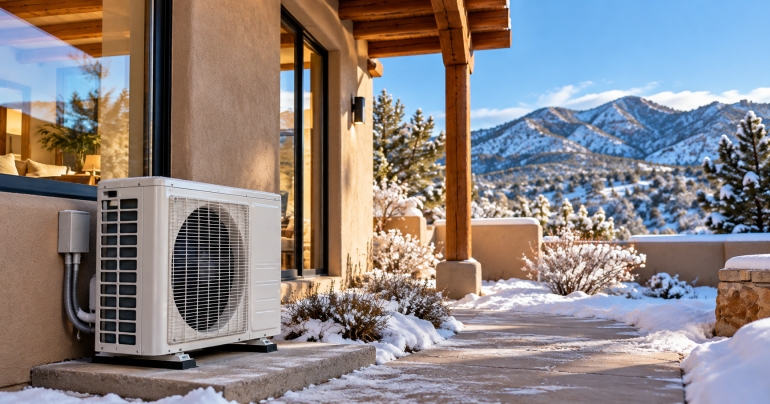
Do Mini Splits Work in Cold Weather? Santa Fe Winter Guide
If you’re considering a ductless mini split for your Santa Fe home, you’ve probably heard plenty about how efficiently these systems cool during the summer. But there’s another question that matters just as much in Northern New Mexico:
Do mini splits actually work when it gets cold outside?
Yes. Modern heat pump mini splits can provide effective heating during Santa Fe winters, including when outdoor temperatures fall below freezing. However, not every mini split has the same cold-weather capabilities. Equipment selection, proper sizing, installation quality, insulation, and the specific low-temperature performance of the system all matter.
That’s especially important in Santa Fe. We enjoy plenty of sunshine, but our elevation and high-desert climate can produce very cold winter nights.
If you’re considering mini split heating in Santa Fe, here’s what you should know about using ductless heat pumps during winter.
How Does Mini Split Heating Work in Cold Weather?
One of the biggest misconceptions about mini splits is that they’re simply air conditioners mounted on the wall.
Most modern ductless mini splits are actually heat pumps.
A heat pump can both cool and heat your home by moving heat rather than creating all of its heat directly through electric resistance.
During summer, the system transfers heat from inside your home to the outdoors.
During winter, that process reverses.
The outdoor unit absorbs available thermal energy from the outside air and transfers it indoors. The indoor unit then distributes that heat throughout the room.
That leads to an obvious question:
How can a heat pump get heat from freezing outdoor air?
Even cold air contains thermal energy. The refrigerant and refrigeration cycle allow a heat pump to capture some of that energy and move it indoors.
As outdoor temperatures fall, extracting that heat becomes more challenging. This is why the cold-weather performance specifications of the equipment are so important.
Do Mini Splits Work Below Freezing?
Yes. Many modern systems continue providing heat at temperatures below 32°F.
Cold-climate mini splits are specifically engineered to maintain useful heating capacity at much lower outdoor temperatures than older generations of heat pumps.
The important distinction is that “operates at a low temperature” and “maintains full heating capacity at that temperature” are not necessarily the same thing.
Every model has its own performance specifications.
A professional HVAC contractor should evaluate data such as:
- Heating capacity
- Rated outdoor temperature
- Minimum operating temperature
- Efficiency at lower temperatures
- Home heating load
- Supplemental heating requirements
This is one reason homeowners shouldn’t choose a mini split based only on the advertised BTU number on the box.
For reliable ductless heating in Santa Fe, the equipment needs to be selected for actual winter conditions.
Why Mini Split Heating Works Well in Santa Fe
Santa Fe presents an interesting environment for heat pumps.
Our winters can certainly get cold, but they’re also characterized by abundant sunshine, dry conditions, and significant temperature changes between daytime and nighttime.
A winter afternoon can feel relatively mild before temperatures drop sharply after sunset.
Variable-speed mini splits are well suited to these changing conditions because they can adjust their output rather than simply operating at full power and shutting off.
When heating demand is relatively low, the compressor can operate at reduced capacity.
As temperatures drop and your home needs more heat, the system can increase its output.
That variable operation can provide both efficiency and consistent indoor comfort.
What Is a Cold-Climate Mini Split?
A cold-climate mini split is a heat pump designed specifically to provide dependable heating at low outdoor temperatures.
These systems often incorporate technologies such as:
- Inverter-driven compressors
- Variable-speed operation
- Advanced refrigerant controls
- Improved defrost strategies
- Enhanced cold-weather heating capacity
The result is a system capable of operating under conditions that would have challenged older heat pump technology.
This distinction is important.
A mini split designed primarily for cooling in a mild climate isn’t necessarily the same equipment you would choose as a major heating source in Northern New Mexico.
When comparing a heat pump mini split in NM, homeowners should look beyond the cooling efficiency rating and evaluate winter performance as well.
Are Mini Splits Energy Efficient for Heating?
Yes, and heating efficiency is one of the strongest arguments for heat pump technology.
Traditional electric resistance heaters create heat directly using electricity.
A heat pump works differently. It uses electricity primarily to move existing heat from one location to another.
Under appropriate operating conditions, this allows a heat pump to deliver more usable heating energy than the electrical energy it consumes.
That can make mini splits particularly attractive for homes currently using:
- Electric baseboard heaters
- Portable electric heaters
- Older electric heating equipment
- Inefficient room-by-room heating systems
Actual savings vary significantly depending on the home, equipment, energy prices, thermostat settings, insulation, and the system being replaced.
Still, a properly selected heat pump can be one of the more efficient ways to heat a home.
What Happens to Mini Split Efficiency When It Gets Very Cold?
Heat pumps generally have to work harder as outdoor temperatures decrease.
That means efficiency and available heating capacity can change with temperature.
This doesn’t mean the system suddenly stops working when the temperature reaches freezing.
Instead, performance changes gradually according to the design of the equipment.
Cold-climate systems are engineered to extend efficient operation into lower temperature ranges.
This is why proper system design matters so much.
Your HVAC contractor should understand how much heat your home requires during cold weather and whether the selected mini split can provide that output at Santa Fe’s winter design conditions.
Why Proper Mini Split Sizing Matters in Santa Fe
Proper sizing is critical for both summer and winter performance.
An undersized system may cool adequately during moderate summer weather but struggle to provide sufficient heat during the coldest winter nights.
An oversized system can introduce its own comfort and efficiency issues.
Professional sizing should consider more than square footage.
Important factors include:
- Home size
- Insulation levels
- Air leakage
- Window size and efficiency
- Ceiling height
- Exterior wall exposure
- Solar exposure
- Home orientation
- Construction type
- Desired indoor temperature
- Local outdoor design temperatures
For a Santa Fe home, characteristics such as thick adobe walls can also affect heating and cooling loads differently from conventional construction.
A professional load calculation provides much better information than a simple “BTUs per square foot” estimate.
Are Mini Splits Good for Adobe Homes in Santa Fe?
They can be an excellent option.
Many older Santa Fe and Northern New Mexico homes weren’t built with conventional forced-air duct systems.
Adding central HVAC to these properties can require significant modifications.
Depending on the house, installing ductwork could involve changes to:
- Ceilings
- Walls
- Closets
- Chases
- Historic architectural details
Ductless systems avoid much of this disruption.
The indoor air handlers connect to an outdoor unit using relatively small refrigerant, electrical, and condensate lines.
That makes mini split heating in Santa Fe particularly attractive for adobe homes where preserving architectural character is important.
Mini Split Heating Is Also Ideal for Casitas and Additions
Santa Fe properties frequently have spaces that don’t fit neatly into the home’s existing HVAC system.
Examples include:
- Casitas
- Guest houses
- Home additions
- Converted garages
- Studios
- Workshops
- Home offices
Extending existing ductwork to these spaces may be difficult or inefficient.
A single-zone mini split can provide independent heating and cooling without requiring the main HVAC system to be redesigned.
This also gives occupants direct control over the temperature of that particular space.
Does a Mini Split Need Backup Heat in Santa Fe?
Sometimes, but not always.
Whether supplemental heating is recommended depends on the specific mini split, the home’s heating load, insulation, system configuration, and the temperatures at which the equipment can maintain sufficient capacity.
Some homeowners use a cold-climate mini split as their primary heating source.
Others combine heat pumps with another heating system.
A home might retain:
- A gas furnace
- A boiler
- Radiant heating
- Another approved supplemental heat source
This can create a flexible heating strategy where the heat pump handles much of the heating season while another system is available when needed.
The correct configuration should be based on the home rather than a blanket rule that applies to every Santa Fe property.
What Is a Mini Split Defrost Cycle?
Homeowners sometimes become concerned when their heat pump behaves differently during cold weather.
One normal winter function is the defrost cycle.
While heating your home, the outdoor coil can become cold enough for frost to accumulate. The system periodically needs to remove that frost so airflow and heat transfer remain efficient.
During defrost, you may notice:
- The outdoor fan temporarily stopping
- A change in system sound
- Steam coming from the outdoor unit
- A brief interruption in normal heating
Steam coming off an outdoor heat pump during defrost can look dramatic on a cold morning, but it can be completely normal.
However, an outdoor unit that remains heavily covered in ice or repeatedly fails to defrost should be inspected by an HVAC professional.
Where Should the Outdoor Mini Split Unit Be Installed?
Outdoor unit placement matters in a climate that can experience snow and freezing conditions.
The unit needs adequate airflow and should be installed according to manufacturer requirements.
Considerations may include:
- Ground clearance
- Snow accumulation
- Roof runoff
- Drainage
- Service access
- Airflow around the equipment
- Ice formation
Simply placing an outdoor unit wherever it’s easiest to run refrigerant lines isn’t always the best long-term solution.
Good installation planning accounts for both summer and winter operation.
Mini Split Heating vs. a Gas Furnace in Santa Fe
Neither system is automatically better for every homeowner.
A gas furnace generates heat through combustion and distributes it through ductwork.
A mini split heat pump transfers heat and doesn’t require traditional ducts.
A furnace may make sense when:
- The home already has good ductwork
- Natural gas is available
- The existing HVAC configuration works well
- The homeowner prefers centralized heating
A mini split may make sense when:
- The home doesn’t have ductwork
- Zoned temperature control is important
- Heating and cooling are needed from one system
- The home has additions or separate living spaces
- Energy efficiency is a major priority
Some homes may even benefit from using both technologies.
The right answer depends on the building and homeowner’s priorities.
Mini Split Heating vs. Electric Baseboard Heat
This is another area where heat pumps can be especially appealing.
Electric baseboard heaters are relatively simple, but each unit produces heat through electrical resistance.
Mini splits move heat instead.
That difference can provide a major efficiency advantage under suitable operating conditions.
Mini splits also provide air conditioning, which baseboard heaters obviously cannot.
For a homeowner looking to upgrade an older electrically heated property, a ductless heat pump in Santa Fe may provide both winter heating and summer cooling through the same equipment.
Will a Mini Split Keep Every Room Warm?
Not automatically.
This is an important point when designing a whole-home ductless system.
A wall-mounted indoor unit heats the zone in which it is installed. Heat can move through open doorways, but homeowners shouldn’t assume that one indoor unit in a living room will evenly heat several closed bedrooms down a hallway.
Whole-home installations may require:
- Multiple wall-mounted units
- Ceiling cassettes
- Concealed ducted air handlers
- A combination of indoor unit types
Good system design focuses on how heat actually moves through the home rather than simply installing the fewest possible indoor units.
How Can You Get Better Winter Performance From a Mini Split?
Equipment selection is only part of the equation.
Homeowners can also help their systems operate efficiently.
Keep filters clean
Restricted airflow can reduce performance and efficiency.
Don’t block the indoor unit
Furniture, curtains, or other objects shouldn’t obstruct airflow.
Keep the outdoor unit clear
Remove excessive snow, leaves, and debris around the outdoor equipment without damaging the unit.
Avoid extreme thermostat changes
Heat pumps generally perform well when maintaining relatively consistent temperatures.
Schedule routine maintenance
Professional service can identify airflow, refrigerant, drainage, electrical, and mechanical issues before they become larger problems.
Improve the home’s building envelope
Air sealing and insulation reduce heating demand regardless of which HVAC technology you use.
So, Do Mini Splits Really Work During Santa Fe Winters?
Yes. Properly selected cold-climate mini splits can provide effective, energy-efficient heating during Santa Fe winters, including periods when temperatures fall below freezing.
The key phrase is properly selected.
A successful system needs to account for:
- Santa Fe’s winter temperatures
- The home’s actual heating load
- The manufacturer’s low-temperature capacity
- Correct equipment sizing
- Proper indoor unit placement
- Professional installation
When those factors are addressed, a ductless heat pump can be much more than a summer air conditioner. It can become a major part of a home’s year-round heating and cooling strategy.
Considering Mini Split Heating in Santa Fe?
If you’re interested in a mini split but concerned about how it will perform during a Northern New Mexico winter, Salazar Heating, Cooling & Plumbing can help you determine whether ductless heating is a good fit for your home.
Our team can evaluate your home’s layout, heating requirements, insulation, existing HVAC equipment, and comfort goals before recommending a system. We’ll help you choose equipment with the appropriate heating capacity for Santa Fe’s climate rather than simply sizing it for summer cooling.
Whether you’re upgrading an adobe home, adding heating and cooling to a casita, replacing inefficient electric heat, or considering a whole-home ductless system, proper design makes all the difference.
Call Salazar Heating, Cooling & Plumbing at (505) 820-2007 to learn more about mini split heating in Santa Fe, NM and find the right year-round comfort solution for your home.